Cheers Sports Bar
Candidate interchange: Town Hall · walking route not yet measured
- Route
- Route not verified
- Access
- Not yet verified
Sydney · Newcastle · Melbourne · Canberra · Wollongong · Geelong
A precise metropolitan guide for adults comparing venue areas, stations, walking routes, parking and accessibility across Australia’s south-east cities.
Research preview · reviewed 4 October 2026 · no live departures · 18+
Choose a metro
01SydneyCBD rail, inner-city light rail and metropolitan interchange access02NewcastleNewcastle Interchange, light rail, Lake Macquarie connections and Greater Newcastle corridors03MelbourneCBD stations, tram corridors and metropolitan rail interchanges04Canberracity bus connections, light rail and town-centre access05WollongongSouth Coast Line stations, city buses and CBD walking routes06GeelongGeelong Station, central bus stops and satellite-city access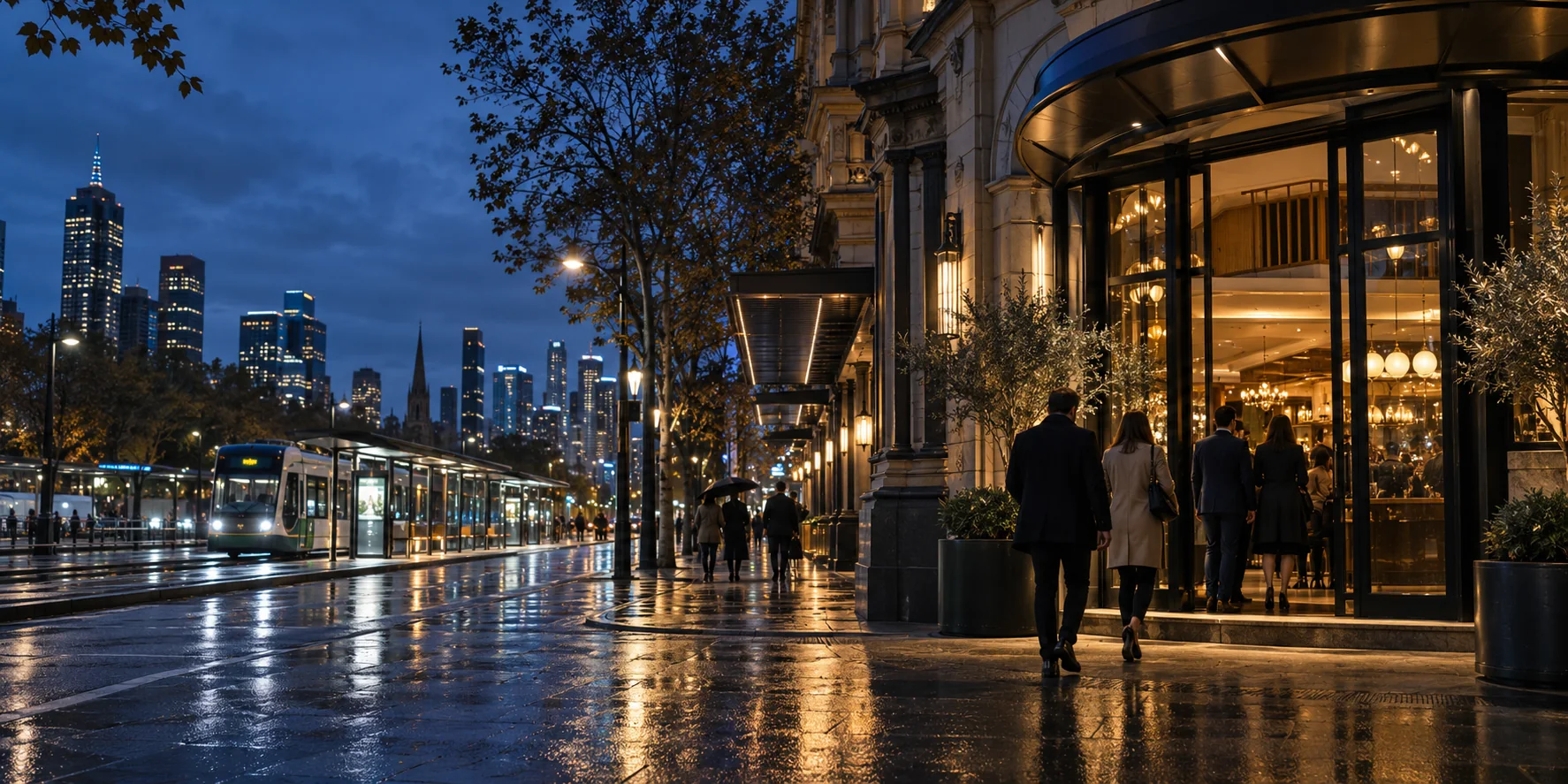
Research review tool
Filter provisional venue candidates by name, station or city. Route times, gaming-room status and access details are not shown until verified.
15 records shown
Candidate interchange: Town Hall · walking route not yet measured
Candidate interchange: Wynyard · walking route not yet measured
Candidate interchange: Parramatta · walking route not yet measured
Candidate interchange: Flagstaff · walking route not yet measured
Candidate interchange: Southern Cross · walking route not yet measured
Candidate interchange: Dandenong · walking route not yet measured
Candidate interchange: Alinga Street · walking route not yet measured
Candidate interchange: Belconnen Interchange · walking route not yet measured
Candidate interchange: Woden Interchange · walking route not yet measured
Candidate interchange: Wollongong · walking route not yet measured
Candidate interchange: Wollongong · walking route not yet measured
Candidate interchange: Shellharbour Junction · walking route not yet measured
Candidate interchange: Geelong · walking route not yet measured
Candidate interchange: South Geelong · walking route not yet measured
Candidate interchange: Marshall · walking route not yet measured
No records match those filters.
Why this guide exists
South-East Metro Pokies Guide is built for a practical urban task: you know roughly where you are, or where you will be, and you want to compare suitable venue areas without opening ten inconsistent directory listings. The guide covers Greater Sydney, Greater Newcastle, metropolitan Melbourne, the ACT and Canberra-Queanbeyan metro intent, Wollongong and Shellharbour, plus Greater Geelong as a separate satellite cluster. It is not a national game guide, a casino review site or a promise that every listed hotel or club currently operates gaming machines.
The working sequence is simple. Pick a city, narrow to a district or station corridor, inspect the evidence status of candidate venues, then verify the exact venue and route using primary sources. This matters because a nearby map pin can still be the wrong choice. The gaming room may keep different hours from the bar. The most obvious station exit may involve stairs. A venue may have parking, but no accessible bay or late access. A last train may leave before the venue closes.
During this pre-publication stage, candidate records are clearly labelled and kept out of search indexing. That makes the interface useful for review without presenting provisional research as fact. A record only becomes indexable when its ownership, address, operator, licence context, gaming-room status, transport route, accessibility information, source dates, internal links and responsible gambling content all pass the publishing gate.
Six metropolitan systems
These are planning differences, not rankings. Availability and venue details require record-level verification.
| Metro | Useful starting point | Transport pattern | Planning caveat | Open guide |
|---|---|---|---|---|
| Sydney | CBD, Parramatta or a major suburban interchange | Heavy rail, Metro, light rail, bus and ferry connections | Large distances and late-night service changes make the exact corridor important | Sydney guide |
| Newcastle | Newcastle Interchange, light rail or a named Greater Newcastle corridor | Intercity rail, light rail, local bus and walking connections | Greater Newcastle ownership does not extend automatically to the Central Coast or wider Hunter | Newcastle guide |
| Melbourne | CBD station, tram corridor or suburban rail centre | Train, tram and bus networks with varied final walking segments | A close tram stop does not always mean a simple accessible path | Melbourne guide |
| Canberra | City, town centre or light rail corridor | Bus interchanges and north-south light rail | Late service frequency and cross-town trips need careful timing | Canberra guide |
| Wollongong | CBD, South Coast Line station or Shellharbour centre | Rail spine with local bus and walking connections | Coastal geography can make a short map distance an indirect route | Wollongong guide |
| Geelong | Central Geelong, a rail station or major bus interchange | Regional rail, local bus and central walking routes | Service frequency differs from inner Melbourne and needs a return plan | Geelong guide |
This is a planning comparison, not a gambling ranking. The best starting point depends on the journey, accessibility needs and verified venue data available.
High-frequency interchange searches, CBD comparisons and district-level planning across a large metropolitan network.
The exact line, station exit, late-night connection and venue-specific gaming-room hours.
Interchange-first planning across Newcastle CBD, light rail and approved Greater Newcastle corridors.
The exact ownership boundary, final walking segment and return connection beyond the central corridor.
Combining train and tram corridors, comparing inner-city precincts and planning a short final walk.
Step-free tram access, replacement services and whether the nearest stop is practical for the full route.
Town-centre comparisons, light rail corridors and bus-interchange planning across the ACT.
Evening frequency, cross-town transfer time and the boundary between Canberra and Queanbeyan intent.
South Coast Line access, central walking routes and comparisons between Wollongong and Shellharbour clusters.
Terrain, indirect coastal walking paths and the last suitable rail or bus connection.
Satellite-city planning around Geelong Station, central bus stops and nearby district hubs.
Return frequency, regional-rail changes and whether a venue belongs inside the Greater Geelong cluster.
Station-first search
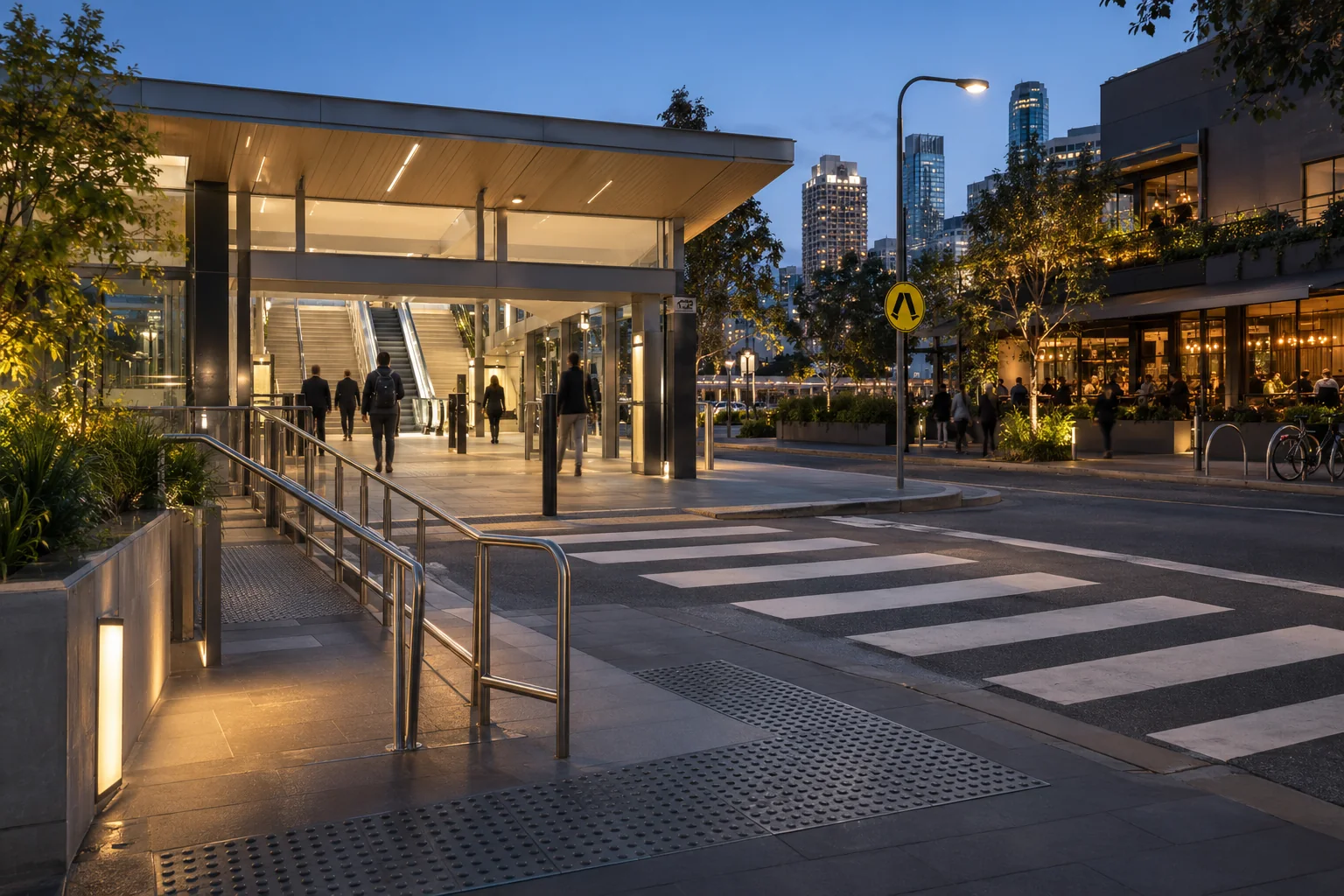
A station-first search reverses the usual venue-directory logic. Instead of selecting a venue from a promotional description and solving the journey afterwards, you begin with a reliable transport node. That can be a Sydney Metro or suburban rail station, Newcastle Interchange or light rail, a Melbourne station or tram corridor, a Canberra light rail stop or town-centre interchange, a South Coast Line station, or the Geelong rail and bus network.
The next step is not to trust a straight-line radius. Walking time should reflect the usable street route, the correct station exit and the venue entrance. Large roads, rail lines, shopping-centre opening hours, gradients and controlled crossings can alter a trip. For accessible planning, the route must also consider lifts, kerbs, surfaces, ramps and the availability of step-free alternatives. The Finder therefore withholds walking times until a route has been measured and checked.
A good route has a fallback. In daytime, that may be the next frequent train or tram. Late at night, it may be a different interchange, a booked taxi rank, a safe pickup point or an earlier departure. The guide does not show live disruptions or departure countdowns because those require an authoritative real-time feed and clear update handling. Use the relevant official journey planner close to departure.
Opening hours and time zones
An open-now filter looks simple, but reliable handling requires more than a weekly timetable. The system must know whether the published hours refer to the whole venue, the bar, the kitchen or the gaming room. It must account for public holidays, temporary closures, daylight-saving changes, after-midnight closing times and the local time zone. Sydney, Newcastle, Canberra and Wollongong use Australia/Sydney, while Melbourne and Geelong use Australia/Melbourne. Those zones often move together, but they should still be stored explicitly.
This preview disables open-now decisions because the venue-specific gaming-room data has not passed that standard. That is more useful than a green badge built from incomplete business-directory hours. When the feature is activated, every result should expose its source, last verification date and any known exception. A stale result should fall back to “hours need checking” rather than remain confidently open or closed.
The same restraint applies to “24 hour” and “open late” searches. These phrases carry strong intent and can change travel decisions. They should only appear when the exact operating period is confirmed from a primary source and regularly refreshed. Even then, users should be reminded that entry conditions and individual facilities can differ.
Parking and accessible paths
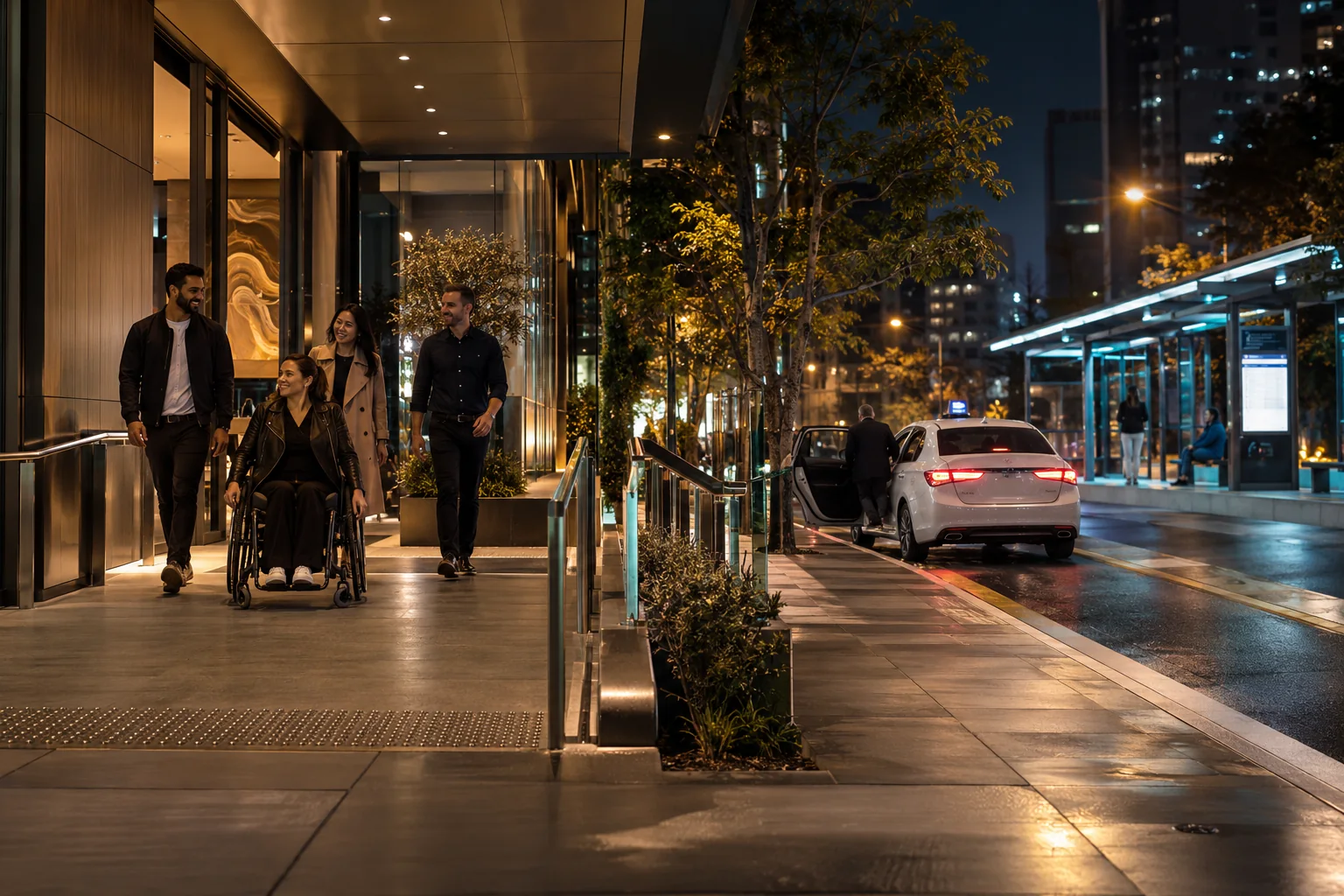
Parking information should distinguish on-site spaces from a nearby public car park. It should explain fees, time limits, clearance restrictions, after-hours access and the walking route back to the vehicle. A generic parking icon is not enough. For a driver with limited mobility, the location of an accessible bay and the gradient to the entrance can matter more than the total number of spaces.
Accessible venue planning also extends beyond the front door. A useful record considers the arrival stop or parking bay, path surface, kerbs, lifts, entrance width, internal circulation and accessible facilities. When an official source only confirms one part of that chain, the page should say so. It should never convert an unverified directory attribute into a blanket accessibility claim.
Users can filter research records by accessibility status, but “not yet verified” does not mean inaccessible. It means the editorial team does not yet hold enough primary-source evidence to make a dependable statement. That distinction protects users from both false reassurance and unfair exclusion.
Before every visit
A two-minute verification pass can prevent a failed trip, an inaccessible arrival or a missed final service.
Evidence over assumptions
Every field has an owner, source and refresh rule.
First, the entity must be identified. A trading name, legal operator and street address can differ across official listings. Alternative names are stored to resolve navigation searches, but the page uses the current official public name. The object is then assigned to one brand under the approved territory and exclusive-owner rules. That prevents two ecosystem sites from publishing competing pages for the same venue or primary intent.
Second, gaming availability needs direct evidence. A pub or club is not assumed to have pokies because a directory, review or old search result says so. The research record seeks an official venue statement, current regulatory source or another suitable primary reference. Licence information is described narrowly. A licence category is not used to imply services or machine counts that the source does not confirm.
Third, the journey is checked. The nearest station or stop is selected by a usable route, not only geographic distance. Walking estimates need a routing method and a date. Parking and accessibility fields remain unknown until supported. Late-night guidance focuses on uncertainty and fallback choices rather than copying a timetable that will become stale.
Finally, the page must add independent practical value. A thin rewrite of official venue copy is not enough. A publishable page compares arrival options, explains district context, exposes caveats, links to related planning pages and provides a useful next action. It includes visible responsible gambling information, a canonical URL, correct structured data, and no review score or aggregate rating unless real, attributable review data exists.
No venue pays for a verification badge or a higher position. Unknown data stays unknown until a suitable source is checked.
We reconcile the public trading name, operator, street address, LGA, locality and exclusive ecosystem owner.
We do not infer pokies availability from an old directory, review, photo or venue category.
The route uses the correct stop, usable exit and pedestrian path, with late-night caveats separated from live data.
Each attribute is narrow and sourced. “Not verified” never gets converted into “not available”.
District comparison
Metropolitan search behaviour does not always follow council or suburb boundaries. A useful district page groups places that share an interchange, evening economy, walking catchment or realistic comparison set. That lets a visitor compare several credible options without opening near-identical pages whose only difference is a suburb name. It also creates room to explain the transport pattern, accessibility constraints, late-night return choices and boundary conditions that affect the whole area.
A separate suburb or station page is justified only when it has independent demand and enough verified evidence to solve a distinct task. It should have multiple relevant records, a useful transport explanation, a comparison or filter, and a clear action. Otherwise, the intent belongs in the stronger district or city hub. Pages that cannot meet that threshold are merged, redirected or kept out of the index rather than expanded with generic copy.
Mobile repeat use
Most planning begins broadly and ends on a phone. The first visit may compare cities, districts and transport modes on a large screen. The repeat visit is more focused: confirm the address, recheck the official route, find the correct station or stop, and review any access caveat. The interface therefore keeps city selection, search, evidence badges and practical links close together instead of placing them behind a decorative travel story.
The static HTML preserves the core records and guidance when JavaScript fails. JavaScript only improves filtering; it does not hide the main content or manufacture facts. Controls use labels, keyboard focus and readable status text. Dense information is broken into consistent rows and tables so it can be scanned without relying on colour alone. This is also the defence against zero-click search: the useful value is the comparison workflow, evidence state and planning action, not a single sentence that can be copied into a summary.
Common questions
No. This local build includes research candidates so the information architecture and filters can be tested. Candidate venue pages are marked noindex and explicitly require primary-source verification before publication.
Reliable open-now logic needs verified gaming-room hours, holiday and exception handling, a local time zone and a refresh process. The preview does not have that complete dataset, so it shows the limitation instead of guessing.
A production walking time needs a dated route calculation and checks for the correct entrances, crossings, gradients and accessibility barriers. Those checks are incomplete, so this preview does not publish estimated minutes.
No. It compares practical attributes and evidence status. It does not invent ratings, reproduce third-party reviews or promise outcomes. Any future top-three module must use a transparent, non-gambling methodology such as transport coverage and data completeness.
National game mechanics, bonuses, providers and payment topics belong to the separate Australia Pokies Guide. This site only covers a regional version when there is an independent metropolitan planning intent and unique local evidence.
It contains provisional research candidates rather than publishable venue records. The tool remains noindex until the underlying identity, gaming-room, route and accessibility evidence passes the publication gate.
Metro bonus · 18+